15 September 2026
Pentesting vs AEV: Which One Actually Reduces Cybersecurity Risk?
Pentesting and AEV serve different security goals. Compare human-led attack discovery with automated continuous validation, and see why combining both can strengthen cybersecurity assurance.
Cybersecurity teams are increasingly adopting automated security technologies that can continuously test whether vulnerabilities and attack techniques can actually be exploited. Automated Exploit and Validation (AEV) is one of the approaches gaining attention because it can provide machine-speed validation across changing environments.
At the same time, penetration testing remains a core part of security assurance. Penetration testers use human expertise to identify attack paths, chain weaknesses, understand application and business logic, and assess the real-world impact of vulnerabilities.
This creates an important question for organizations: should AEV replace penetration testing, or do both serve different purposes?
The answer is important not only from a technical risk perspective but also from a regulatory and governance perspective.
What Is Automated Exploit and Validation (AEV)?
Automated Exploit and Validation (AEV) goes beyond conventional vulnerability scanning. Instead of simply identifying a vulnerability, an AEV platform attempts to validate whether security weaknesses can actually be exploited using automated attack techniques.
Depending on the platform, this may include exploiting known vulnerabilities, executing attack techniques, validating attack paths and testing security controls against techniques mapped to frameworks such as MITRE ATT&CK.
The key difference is that AEV attempts to answer a practical question:
“Can this weakness actually be exploited in this environment?”
This can produce useful evidence for security teams because it helps distinguish theoretical vulnerabilities from weaknesses that are demonstrably exploitable.
AEV can also be repeated frequently, making it useful for environments where infrastructure, cloud workloads, applications and configurations change continuously.
Why Security Teams Are Turning to AEV
Traditional security testing can be periodic. A company may conduct a penetration test once or twice a year, remediate findings and then gradually accumulate configuration changes, new systems and new vulnerabilities before the next assessment.
AEV addresses part of this problem through continuous or frequent validation.
Its major advantages include:
- Faster validation of known attack techniques
- Frequent testing of changing environments
- Verification that security controls are actually preventing exploitation
- Validation of remediation efforts
- Reduced reliance on manual testing for repetitive attack scenarios
- Greater visibility into security drift between formal assessments
For organizations operating large cloud, hybrid or distributed environments, this continuous validation can be particularly valuable.
However, AEV should not be confused with a complete security assessment.
What AEV Cannot Replace
AEV is powerful when the objective is repeatable, automated validation. It becomes less effective when the assessment requires interpretation, creativity and an understanding of organizational context.
Automated platforms are generally limited when dealing with complex business logic, unusual attack scenarios and weaknesses that require a tester to make decisions based on what they discover during an assessment.
For example, a banking application might have a technically secure authentication mechanism but still contain a business logic flaw allowing a user to manipulate transaction workflows. Identifying such a weakness may require understanding how several application functions interact rather than simply executing a known exploit.
Similarly, an attacker may discover a combination of relatively low-risk weaknesses and chain them into a significant compromise. Human penetration testers can investigate these relationships dynamically and change their testing strategy based on what they discover.
AEV can therefore provide strong validation, but it does not eliminate the need for human-led security testing.
Why Human-Led Penetration Testing Still Matters
Penetration testing is designed to simulate realistic attacks using human expertise.
A skilled penetration tester does not simply follow a predefined list of vulnerabilities. They investigate the target, identify weaknesses, understand how different components interact and develop attack paths based on the evidence discovered during the assessment.
This is particularly important for:
Unknown or Unexpected Attack Paths
A tester can discover attack paths that were not anticipated when the test began and combine multiple weaknesses to achieve a larger objective.
Business Logic
Applications often contain workflows that cannot be adequately assessed by automated exploitation alone. Authorization flaws, transaction manipulation, privilege abuse and workflow bypasses can require significant human reasoning.
Context and Business Impact
A penetration tester can determine how a technical weakness affects the organization and whether it can lead to sensitive data exposure, unauthorized transactions, privilege escalation or operational disruption.
Creative Attack Techniques
Attackers do not necessarily use only known techniques. Human testers can adapt their approach when the environment behaves differently from expected.
This makes penetration testing particularly useful for establishing a security baseline.
Pentesting vs AEV: The Key Differences
The two approaches overlap in some areas, but their strengths are different.
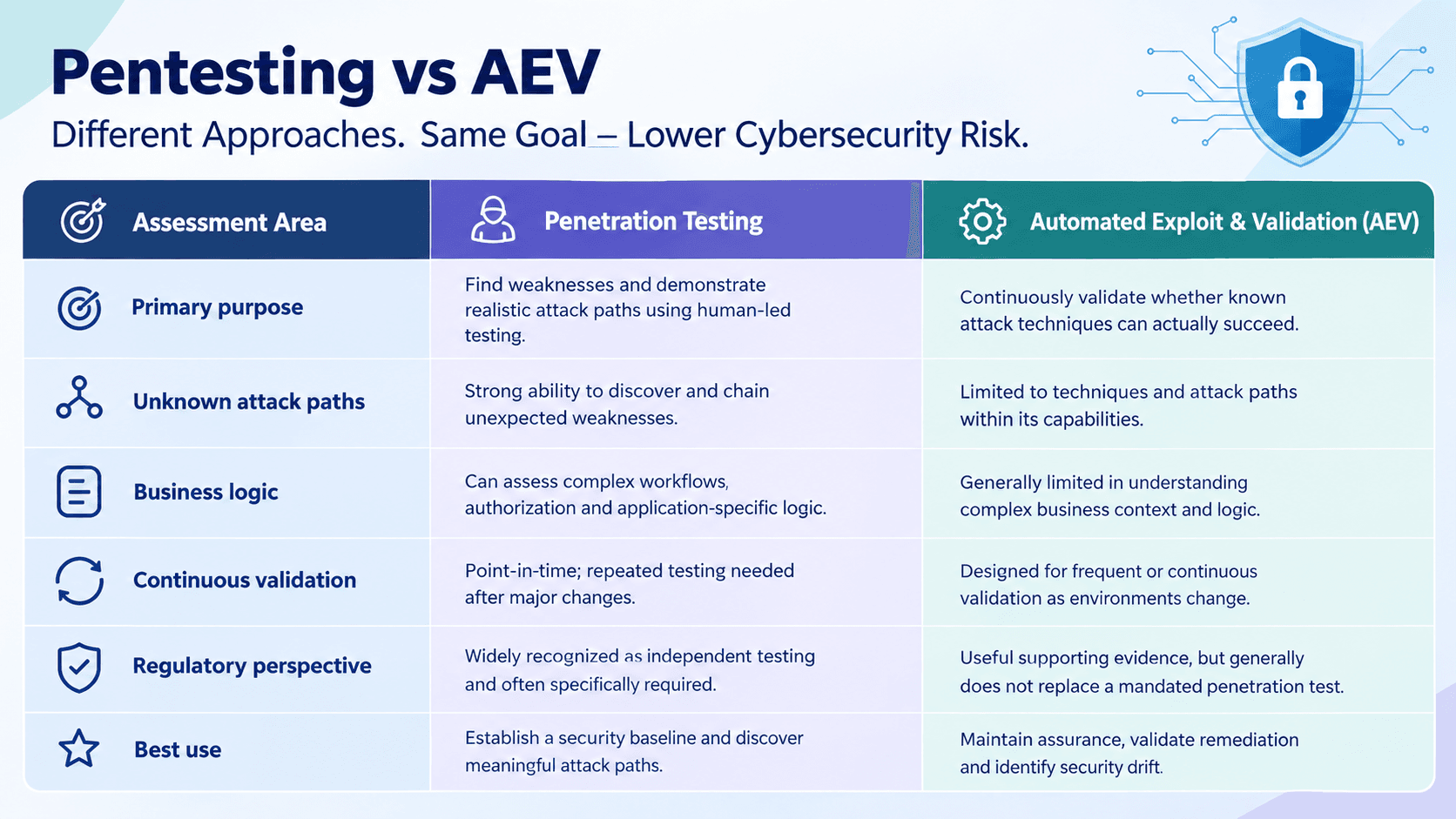
AEV and Penetration Testing Measure Different Things
Penetration testing is primarily concerned with finding and demonstrating risk.
AEV is primarily concerned with continuously validating whether security weaknesses and attack techniques can succeed.
A penetration test may uncover an attack chain that was never previously identified. AEV can then be useful for repeatedly validating whether that attack path remains possible after remediation or environmental changes.
This makes the two approaches complementary.
For example, a penetration tester may identify a vulnerable external service, combine it with excessive permissions and ultimately demonstrate access to sensitive systems. After remediation, automated validation could repeatedly test the relevant attack techniques to determine whether the environment remains resistant.
In this model, penetration testing provides the human-led discovery and AEV provides ongoing validation.
Why Penetration Testing Should Usually Come First
For organizations that have not yet established a strong security testing baseline, penetration testing should generally come first.
The first objective should be understanding the organization's actual attack surface and identifying weaknesses that matter in the context of the business.
A well-executed penetration test can establish that baseline by examining applications, infrastructure, networks, cloud environments and authentication mechanisms from an attacker's perspective.
Once the most significant weaknesses have been identified and remediated, AEV can add another layer of assurance by repeatedly testing whether known attack techniques continue to work.
This creates a logical progression:
Discover → Remediate → Validate → Continuously Monitor
Rather than replacing penetration testing, AEV becomes more valuable when there is already a strong understanding of the organization's security weaknesses.
Where AEV Adds the Most Value
AEV becomes particularly useful in environments where changes happen too quickly for periodic assessments alone to provide sufficient assurance.
Cloud infrastructure, DevOps pipelines, internet-facing services and large enterprise networks can change continuously. New systems may be deployed, permissions modified and security controls reconfigured within days or even hours.
In such environments, an annual or periodic penetration test can become outdated as the environment evolves.
AEV can help maintain a more current view of whether important attack techniques remain viable.
It is also useful for remediation validation. Rather than waiting until the next scheduled assessment to determine whether a security fix worked, organizations can use automated validation to test the relevant attack conditions much sooner.
This can reduce the gap between remediation and verification.
The Best Approach: Pentesting + AEV
For mature security programs, the strongest model is usually a combination of both approaches.
Step 1: Establish the Baseline
Conduct penetration testing to identify vulnerabilities, attack paths, business logic weaknesses and security control gaps.
Step 2: Remediate
Address the vulnerabilities and weaknesses based on their business impact and risk.
Step 3: Validate
Use AEV to confirm that known exploitation paths have been closed and that security controls are preventing the expected attack techniques.
Step 4: Monitor Changes
Continue automated validation as infrastructure, applications and cloud environments change.
Step 5: Reassess Periodically
Perform new penetration tests to identify new attack paths, emerging weaknesses and risks that automated validation may not detect.
This model combines human creativity with continuous machine-speed validation.
What About Cloud, Hybrid and OT Environments?
Cloud and hybrid environments can benefit significantly from continuous validation because their attack surfaces change rapidly.
However, the testing approach should still reflect the nature of the environment.
For OT and critical infrastructure, automated exploitation requires additional care because aggressive testing can potentially affect availability or operational processes. Testing safety, production impact and operational constraints should therefore be considered before deploying automated attack validation.
The objective is not to maximize the number of attacks executed. It is to obtain useful security assurance without creating unnecessary operational risk.
Which Approach Should Your Organization Choose?
Organizations should generally prioritize penetration testing when they need to establish or reassess their security baseline, investigate complex applications, test business logic or satisfy a requirement for independent security testing.
AEV becomes particularly valuable when the organization already has a security testing foundation and wants continuous validation between formal assessments.
For organizations operating highly dynamic environments, combining the two can provide substantially better coverage than relying exclusively on either approach.
The choice therefore does not need to be Pentesting or AEV.
In many cases, the better question is:
How can AEV extend the value of penetration testing?
The Bottom Line: AEV Does Not Make Pentesting Obsolete
Automated Exploit and Validation can significantly improve security assurance by continuously testing whether known attack techniques and vulnerabilities remain exploitable.
But cybersecurity risk is not limited to known vulnerabilities.
Unknown attack paths, application logic, complex attack chains and business-specific weaknesses still require human expertise.
Penetration testing and AEV therefore solve different problems.
Penetration testing helps organizations discover how they can be compromised. AEV helps them continuously verify whether those paths and techniques can still succeed.
For most mature security programs, the strongest strategy is not choosing one over the other, but using penetration testing for discovery and AEV for continuous validation.
How Axpert Cyber Can Help
Axpert Cyber provides both penetration testing and continuous security validation services and solutions, helping organizations build a layered approach to cybersecurity assurance.
Our assessments can cover web and mobile applications, APIs, network infrastructure, cloud environments and external attack surfaces, while automated validation can complement periodic testing by helping organizations verify remediation and monitor security changes over time.
For organizations looking to move from periodic security testing toward a more continuous risk-validation model, combining expert-led penetration testing with automated security validation can provide a more practical and sustainable approach to reducing cyber risk.